
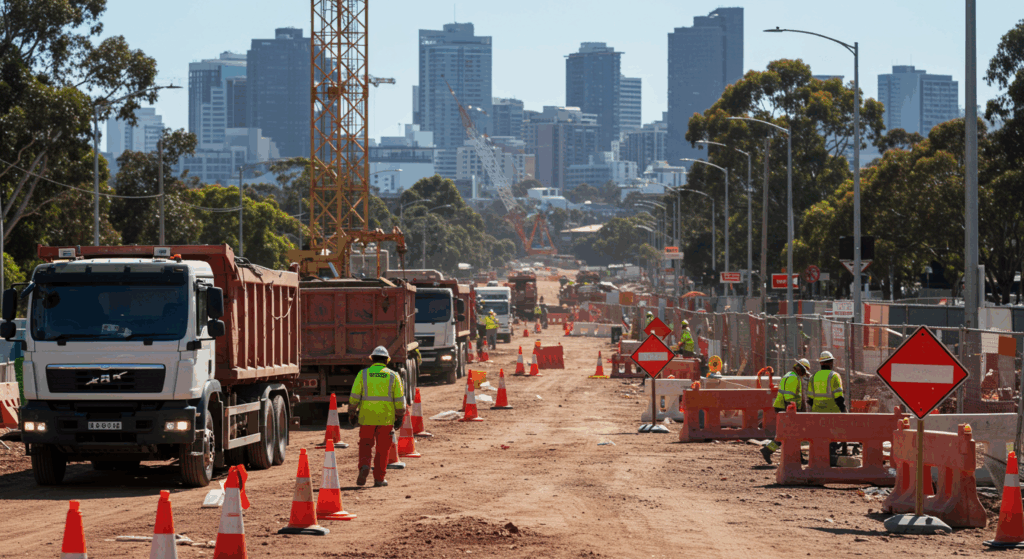
On a busy construction site, trucks carry heavy loads, cranes move overhead, and pedestrians can sometimes get too close to danger. In these situations, even a small mistake can lead to serious accidents. A Traffic Management Plan provides clear guidance to ensure vehicles, machinery, and people move safely without confusion.
Traffic Products Australia makes it simple to turn a Traffic Management Plan into a practical, easy-to-follow system. Our guides, compliant signage, barriers, and ready-made templates help you plan more efficiently, gain approvals more easily, and set up safely on-site. This article will guide you through defining roles, identifying risks, implementing controls, and conducting daily checks with confidence. Let’s begin with the purpose of a Traffic Management Plan.
Purpose of a Traffic Management Plan
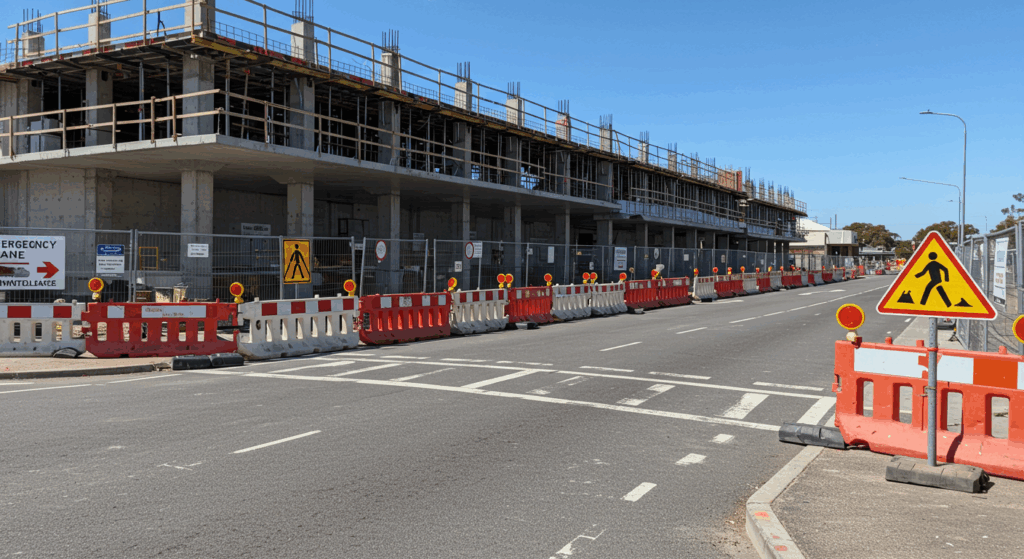
The main purpose of a Traffic Management Plan is to stop collisions between vehicles, equipment, and people on construction sites. A well-prepared plan confirms that risks are identified, checked, and controlled under the Work Health and Safety Act. It also shows care for the community and environment, like keeping access open for residents and emergency vehicles.
A well-prepared plan confirms that risks are identified, assessed, and managed in line with the Work Health and Safety Act. It also ensures community and environmental needs are considered, including access for residents and emergency services.
Traffic Management Plan Rules
Different levels of authority make the rules for Traffic Management Plans.:
- National level
- Safe Work Organisation gives the overall safety guidance for workplaces.
- Austroads sets the main principles for temporary traffic management that apply everywhere in the country.
- AS 1742.3:2019 is a national standard that explains exactly how traffic control devices (like signs, cones, and barriers) should be placed.
- Safe Work Organisation gives the overall safety guidance for workplaces.
- State level
- Each state then has its own authority that adds more detailed rules.
- Main Roads WA in Western Australia
- Transport for NSW in New South Wales
- WorkSafe Queensland in Queensland
- These groups create their own codes of practice and manuals with instructions specific to their region.
- Each state then has its own authority that adds more detailed rules.
- What this means
- Together, the national rules and the state rules form the official benchmark. This is what every TMP is checked against to make sure it is legal, safe, and approved.
Major Characteristics of a TMP
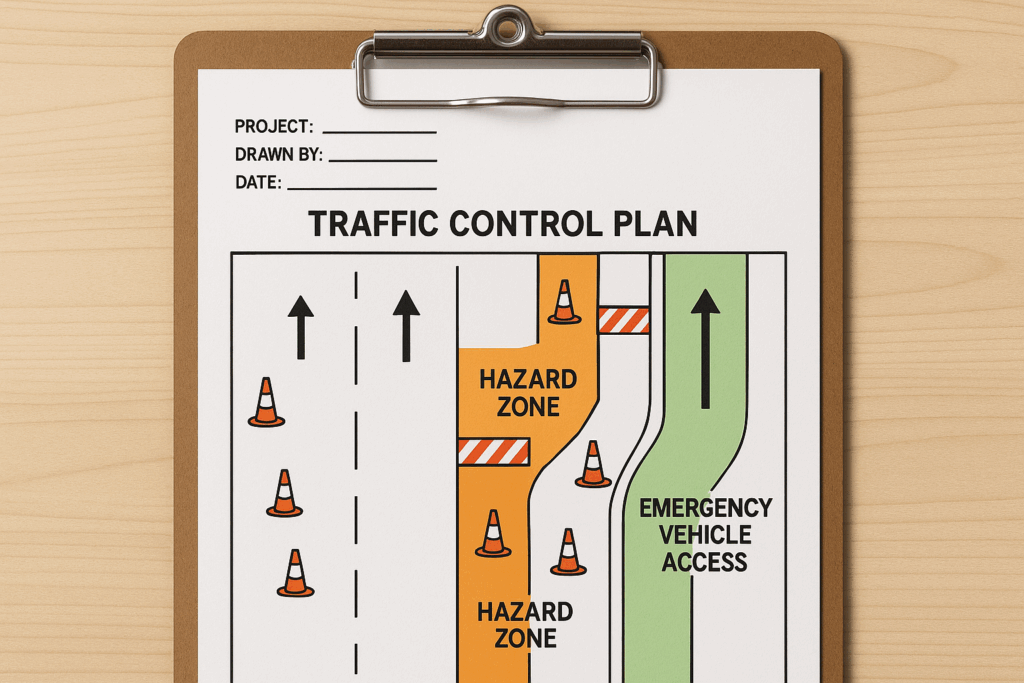
Every plan should include a few core parts to work properly:
- Project details: What the work involves, where it is happening, and when it will take place.
- Traffic flows: Diagrams or traffic control plans showing how vehicles, machines, and pedestrians will move safely.
- Hazard identification: Areas where risks may occur and what will be done to reduce them.
- Control measures: The barriers, diversions, signs, and staff needed to manage movements.
- Emergency arrangements: Clear access for ambulances and fire services, plus steps for responding to incidents.
- Monitoring and review: How the plan will be checked, audited, and updated as conditions change.
These parts turn a TMP from a basic checklist into a working guide that directs the daily running of a site.
Planning and Design Principles
Good planning means thinking about how traffic will move, and what could go wrong if it isn’t managed properly. The layout should always try to keep heavy vehicles and pedestrians apart. Entry points need to be wide enough for trucks to pass safely without putting people on nearby footpaths at risk. Parking spaces, delivery areas, and storage zones should be marked clearly and supported with clear signage.
The design also depends on the type of project. A high-rise site in a busy city may need lane closures, detours, and staged works, while a suburban project may rely more on lower speed limits and temporary pedestrian crossings. Traffic control plans make this clear by showing exactly where signs, cones, and barriers will be placed on the ground.
Risk Assessment and Control Measures
Before work starts, it’s important to check site risks like trucks reversing, tight spaces, or shared access. Every risk needs to be checked and handled.
Practical ways to control these risks include:
- Putting barriers in place to keep vehicles and pedestrians apart.
- Having trained spotters to guide trucks when they reverse.
- Planning deliveries at quieter times to reduce traffic around the site.
- Making sure workers wear high-visibility clothing and have good lighting for night work.
These steps form the core of a TMP, proving that risks are being actively managed rather than left to chance.
Roles and Responsibilities
Properly defined roles maintain a Traffic Management Plan in operation. Three important roles are typically defined:
- Traffic Management Designer: prepares the plan, making sure it meets standards and deals with site risks.
- Traffic Management Supervisor: Manages the plan on site, checking that it is followed correctly.
- Traffic Controllers or Implementers: Set up and maintain equipment, guide vehicles, and monitor safety during operations.
By clearly defining these roles, the TMP establishes accountability and reduces confusion, ensuring everyone knows their responsibilities.
Implementation Procedures
Implementing a traffic control plan requires a precise sequence of steps. The work starts with clearing, preparation of the site, and marking lines, and then the designation of staging points. Then, the equipment is arranged in an organised manner, usually starting from the most protected side of the traffic flow. Traffic controllers must be placed before any barriers are moved.
Daily checks are important to make sure cones, signs, and barriers stay in place and remain in good condition. If site conditions change, such as weather or work stages, the plan may need updating. Documenting the process helps prove compliance and ensures the site can be checked properly.
Communication and Stakeholder Management
Clear signage and public notices help reduce frustration for road users and keep traffic moving. Inside the site, communication is equally important. Inductions, toolbox talks, and daily briefings make sure all workers understand how the TMP works. Coordination between subcontractors and delivery drivers is also critical, especially when several trades are using the same access routes.
Conclusion
Construction sites are active environments in which traffic hazards need to be controlled properly. A well-prepared management plan brings order to complexity, protecting workers, the public, and the project itself. By following recognised standards, using risk-based controls, and applying tools such as traffic control plans and templates, site managers and engineers can develop plans that are both compliant and practical.In the end, the success of a Traffic Management Plan is a result of maintaining both safety and productivity. With careful planning, ongoing review, and the proper equipment from Traffic Products Australia, projects can move forward confidently while protecting people and the community.